AI in Homoeopathy: From Case Taking to Follow-up Care
November 04, 2026 | Wednesday | Views | By Tejesh Vaish, Founder of Homeo AI and IIT Kanpur alumnus (homeo-ai.com)
AI can support the work around a consultation by connecting case information, reference passages, and observations at follow-up
Case taking continues after the patient's initial account has been recorded. A doctor may need to clarify when a symptom began or return to a reference after new information emerges. If a symptom description changes, the doctor also needs to know which earlier searches relied on it.
A practical direction for AI in homoeopathic practice is to preserve this continuity. Connecting the case record with the reference work it prompts and the observations added later gives the practitioner material to examine. Clinical interpretation remains with the doctor, who can question a suggestion and trace it back to the account or passage on which it rests.
Starting with a usable case record
A summary can be fluent while leaving out the circumstances that give a symptom its meaning. Onset, sensations, and aggravating or relieving factors need to remain visible when the patient's words are organised into a case record. AI can help arrange that information while retaining the original account for comparison.
Conversational questioning can use an earlier answer to identify what still needs clarification. A structured form offers a different route, keeping the record organised around fields the doctor can review. In either approach, retaining unanswered questions leaves them available for the next discussion. The practitioner can correct a description before using it for further analysis.
Patient statements, contents of an uploaded report, and generated suggestions have different origins. Keeping those origins visible helps the doctor distinguish a proposed interpretation from something the patient reported. Reference research can then begin with an identifiable input, with the supplied detail and any assumption open to examination.
Making reference research open to examination
Choosing a repertory rubric involves interpreting the patient's words. The rubric groups symptoms under a reference heading with associated remedy entries; materia medica provides fuller descriptions of those remedies. AI can link the chosen heading to the case wording and relevant passages, giving the practitioner a route back through that interpretation.
Placing a case detail beside a suggested rubric and its source lets the doctor inspect the relationship directly. A comparison of remedy descriptions can retain the passages that distinguish them, including qualifications that a summary might omit. In a teaching clinic, the same material gives a tutor a basis for discussing why a rubric was selected and whether the patient's account supports that choice.
Correcting a symptom description may alter the query and the passages worth consulting. Keeping the earlier search linked to its original case details preserves the basis of that search. The doctor can examine why the reference work changed instead of having to reconstruct it from the latest answer.
What happens between a question and an answer
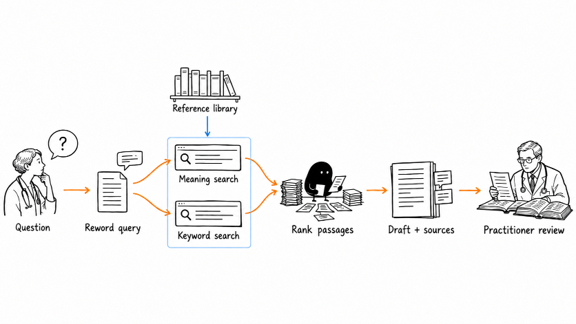
One possible architecture begins by dividing reference texts into passages, each stored with its title and location. Embeddings represent those passages numerically so an index can organise them for searches based on meaning. Retrieval-augmented generation connects an external collection with a language model. Passage boundaries matter because an extract can lose the surrounding qualification that explains it.
The system can search related formulations of the practitioner's question alongside its original wording. Meaning-based search looks for conceptually related passages, while BM25 ranks passages through keyword matching. Hybrid search brings these results together. After merging results and removing duplicates, a reranking stage can compare the remaining passages with the question and reorder them. This preserves a role for specific reference terms when the practitioner and source use different phrasing.
Selected passages and relevant case context can then accompany the question sent to a language model. The model drafts a response, with source passages available for review. Retrieval relevance describes a match to a query; it does not establish clinical validity. The doctor can compare the draft with the cited passages to examine what has been condensed or inferred before adding it to the case record.
Carrying context into the next consultation
At follow-up, the earlier account provides a baseline for understanding what the patient now reports. A useful record keeps those later observations distinct from the original symptoms and the doctor's previous interpretation. AI can place the entries alongside each other, allowing the practitioner to examine what changed without rewriting the history around the latest account.
Comparison can also bring unresolved questions and corrections back into view. The doctor can revisit a detail that was uncertain, check whether it was later clarified, and decide whether earlier reference work still applies. A system can retrieve stored context for a new response without continually retraining the underlying model; the continuity comes from the record made available to it.
An export that keeps notes, amendments, and cited passages together lets the doctor return to the reasoning outside a chat interface. A summary stripped of those links can leave the conclusion visible while obscuring how it was reached. Readable, retrievable records keep the earlier work open to review after the immediate exchange has ended.
Making continuity the measure of usefulness
These uses have to fit the rhythm of a consultation. A doctor who dictates a note still needs to correct a mistranscribed term; a translated response needs a route back to the original wording. Source passages have to remain accessible while the answer is being read. Long waits or repeated copying between screens interrupt that review, so response time and input choices belong in the same discussion as retrieval design.
For clinics and teaching institutions in India, this puts the emphasis on preserving the reasoning behind the work. A case discussed in teaching or returned to at follow-up needs the patient's account, the references consulted, and the practitioner's interpretation to remain distinguishable. Such a record lets the doctor return to the basis of an earlier interpretation when new information calls it into question.
Tejesh Vaish, Founder of Homeo AI and IIT Kanpur alumnus (homeo-ai.com)