GIC 2026 unveils distinguished speaker lineup for India’s largest genomics conference
August 21, 2026 | Friday | News
India’s potential participation in Human Genome Project II and the next large-scale sequencing initiative for the Indian population to feature prominently at the conference
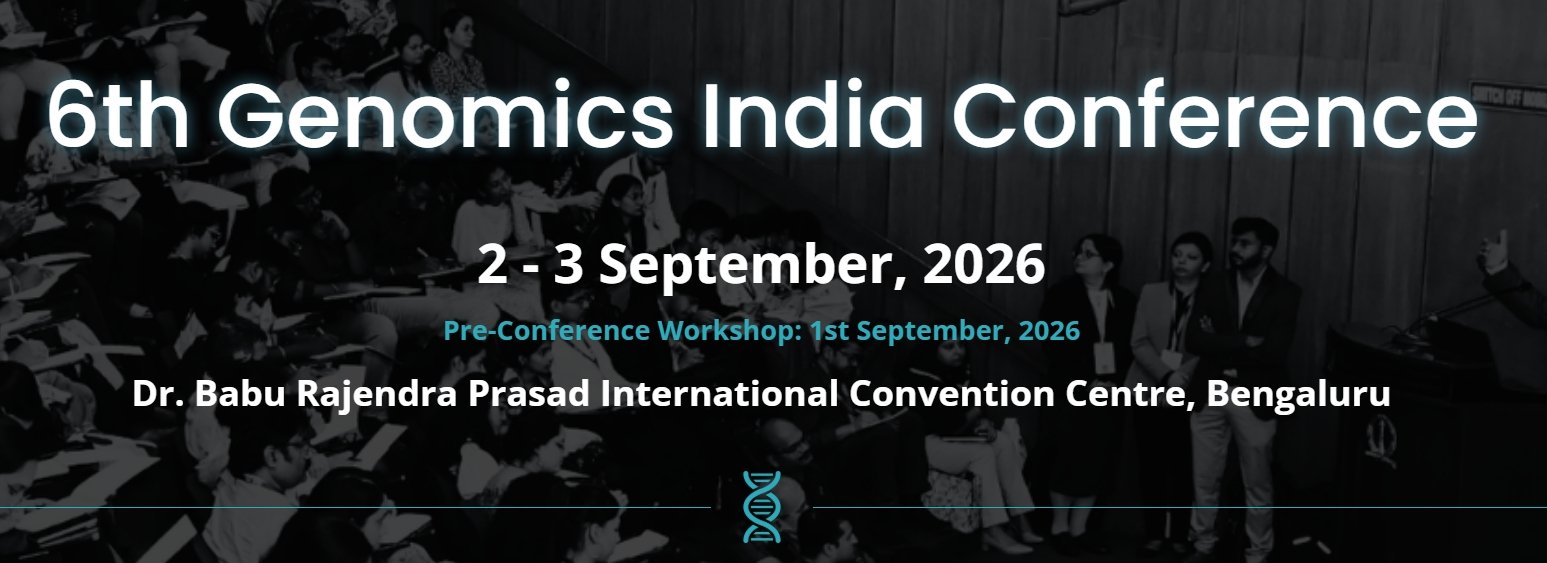
Genomics India Conference (GIC) 2026 has unveiled its distinguished speaker lineup for the sixth edition of India’s largest genomics conference, scheduled to take place on 2–3 September 2026 at the Dr Babu Rajendra Prasad International Convention Centre, GKVK Campus, Bengaluru.
The conference is being jointly organised by Genotypic Technology, the University of Agricultural Sciences (UAS), the National Centre for Biological Sciences (NCBS), the Indian Institute of Science (IISc) and the Tata Institute for Genetics and Society (TIGS).
Centred on the theme “Genome to Bioeconomy: Innovation, Impact and Economic Transformation,” GIC 2026 will convene global genomics pioneers, senior policymakers, industry leaders and some of India’s foremost researchers to examine how genomic science can generate measurable healthcare, agricultural, environmental and economic impact.
A major focus of the conference will be the proposed Human Genome Project II (HGP2) and the opportunities surrounding India’s participation in this international initiative. Discussions will also explore the need for a next-generation, large-scale sequencing programme representing the diversity of the Indian population and its potential to strengthen precision medicine, public health, research infrastructure and the country’s emerging genomics-driven bioeconomy.
Dr Beena Pillai to deliver inaugural lecture
Dr Beena Pillai, Director, BRIC–Rajiv Gandhi Centre for Biotechnology (BRIC-RGCB), Thiruvananthapuram, will deliver the inaugural lecture at GIC 2026. Her address will formally open the sixth edition of the conference and set the stage for two days of scientific and strategic discussions on translating genomic discoveries into applications that benefit society and the economy.
Global genomics luminaries to deliver keynote addresses
GIC 2026 will welcome three internationally recognised leaders whose work spans the foundational science of genome analysis, multi-omics and personalised medicine, and the development of global genomic infrastructure.
Prof Charles R. Cantor, Professor Emeritus of Biomedical Engineering, Boston University, USA
Prof Charles R. Cantor is one of the founding architects of human genome science. His pioneering research encompasses biophysical tools for human genome analysis, methods for separating large DNA molecules, sensitive detection of proteins and nucleic acids, faster DNA-sequencing technologies and novel variations of the polymerase chain reaction.
He has also investigated the application of biological molecules in nanoengineering and single-molecule detection. His contributions have helped establish many of the foundational methodologies that continue to underpin modern genomics and molecular diagnostics.
Prof Michael P. Snyder, PhD, Stanford W. Ascherman Professor and Chair of Genetics; Director, Center for Genomics and Personalized Medicine, Stanford University, USA
Prof Michael P. Snyder is a global leader in functional genomics, multi-omics and personalised medicine. His laboratory conducted the first large-scale functional genomics project in any organism and has developed transformative technologies including RNA sequencing, proteome chips, high-resolution tiling arrays and ChIP-seq.
A major contributor to the ENCODE project, Prof Snyder pioneered longitudinal multi-omics health profiling. His research involving wearable technologies, artificial intelligence-driven health monitoring and exposomics is helping move healthcare towards continuous, predictive and preventive models.
Dr Weibin Liu, Vice President and Special Assistant to the Chairman, BGI Group, China
Dr Weibin Liu is Vice President of BGI Group and a co-initiator of Human Genome Project II, a proposed global initiative that aims to sequence at least one per cent of the world’s population and apply genomic knowledge to advance precision public health.
At the 30th Anniversary Meeting of the Bermuda Principles in February 2026, Dr Liu outlined the strategic vision for HGP2 and BGI’s commitment to open science, including the release of Genos, an open-source, human-centric genomic foundation model with 10 billion parameters.
His keynote at GIC 2026 will address the transition from large-scale genomic data generation to public-health applications, global scientific collaboration and bioeconomic value creation.
“We are honoured to welcome Prof Charles Cantor, Prof Michael Snyder and Dr Weibin Liu to GIC 2026. Together, they represent the full arc of genomics—from the foundational science that made the genome readable and the multi-omics revolution transforming medicine to the global infrastructure now scaling genomics into a true bioeconomy. That arc is exactly what GIC 2026 is about,” said Dr Raja Mugasimangalam, Founder and CEO, Genotypic Technology.
“Human Genome Project II presents an important opportunity to build a more inclusive global understanding of human genomic diversity. GIC 2026 will provide a timely platform to examine how India can contribute to this effort and shape a large-scale sequencing programme that represents the extraordinary genetic diversity of its population,” he added.
More than 60 experts to participate
GIC 2026 will bring together more than 60 speakers, session chairs and panellists from leading research institutions, universities, hospitals and genomics organisations in India and overseas.
The participating institutions include CSIR–Centre for Cellular and Molecular Biology, BRIC–Centre for DNA Fingerprinting and Diagnostics, IIT Roorkee, the Indian Institute of Science Education and Research Kolkata and several other prominent centres of research and innovation.
The conference programme will cover human health and precision medicine, population genomics, multi-omics, artificial intelligence, agriculture, metagenomics, diagnostics, bioinformatics and the wider genomics bioeconomy.
Seven pre-conference workshops announced
Seven specialised pre-conference workshops will be conducted on 1 September 2026:
- Statistical Genomics — National Centre for Biological Sciences
- Metagenomics for Clinical and Environmental Applications — Tata Institute for Genetics and Society
- AI Driven Multi-Omics— Indian Institute of Science
- Phenomics and Hologenomics in Modern Agriculture — University of Agricultural Sciences
- AI-Driven NGS Data Analysis — Genotypic Technology
- Long-Read Sequencing Using Agilent Target Enrichment — Agilent Technologies
- From FASTQ to Actionable Insight: Demonstration of the Meril Genomics Multi-Omics Bioinformatics Workbench — Meril Genomics
More information about the conference and its speaker faculty is available at www.genomicsindia.co.in.
GIC 2026 is not just an event—it is the “Home of Genomics”: a place where genomes meet growth, data meets destiny and science quietly becomes economy.