India 2030: Who Supplies the Next 10 Million?
November 01, 2026 | Sunday | Features | By Ankit Kankar
India’s diabetes market is entering a defining decade. The withdrawal of selected human insulin pens by Novo Nordisk, the arrival of once-weekly insulin, the rapid expansion of generic semaglutide and the growing adoption of glucose-monitoring technologies are reshaping competition. As pharmaceutical companies and technology providers reposition themselves, the market is splitting into four distinct territories: mass-market insulin, premium insulin, diabetes technology and therapies that may delay insulin initiation. This cover story examines the companies, strategies and innovations shaping the next phase of growth, and asks whether market expansion will translate into better, more affordable diabetes care for millions of Indians.
image credit- shutterstock
The battle for India’s diabetes market is no longer simply about who sells the most insulin. It is about who can reach more patients, make treatment affordable and respond to changing preferences. Novo Nordisk’s retreat from selected human insulin pens, a once-weekly insulin priced at Rs 261 a week and the influx of generic semaglutide have accelerated this shift. The companies that succeed by 2030 will be those that identify their competitive territory early.
India has never had a shortage of people who need insulin. It has had a shortage of people who get it.
More than 101 million Indians live with diabetes and another 136 million have prediabetes, according to the ICMR-INDIAB figures Novo Nordisk cited when it launched its once-weekly insulin in July. Against that, roughly 6 million people are on insulin therapy. Vikrant Shrotriya, Managing Director of Novo Nordisk India, told reporters at the launch that the company expects that number to rise to 9 million in the near future, acknowledging that this growth would also create business opportunities.
Six million treated out of more than a hundred million people living with diabetes is not just a market opportunity. It is a significant treatment gap. The average Indian patient stays on oral medicines for seven to nine years before starting insulin, even when clinical circumstances may warrant earlier initiation. The reasons are familiar: fear of injections, anticipated pain, treatment complexity and cost.
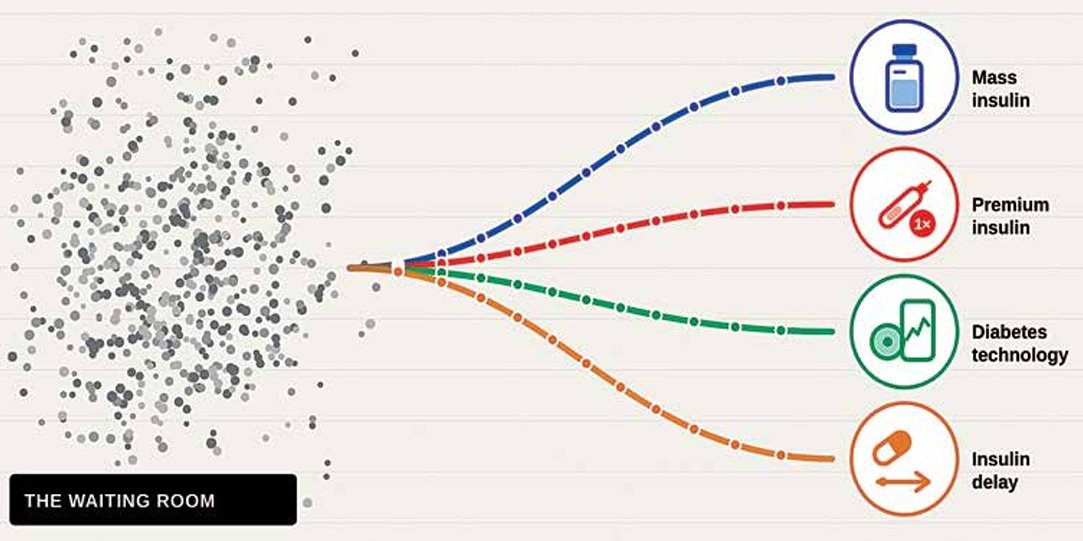
Call the people who will walk out of that waiting room between now and 2030 the next 10 million. The figure is our working frame rather than a census count, but the direction is not in doubt. Some of them will get human insulin from a vial at a district clinic. Some will get a pen they use once a week. Some will wear a sensor that talks to their phone. And a growing number may never start insulin at all, because a GLP-1 bought them another five years.
That last possibility is what makes this decade different. For most of the past thirty years, the question in Indian diabetes care was which insulin. By 2030 it will be which market. What used to be one category has split into four territories, each with its own economics, its own buyers and its own likely winners. This analysis maps them, and then puts one question to the companies fighting over them.
The year the incumbents stepped back
The fracture began with a retreat. In 2025, Novo Nordisk told Abbott India, its marketing partner, that human insulin in Penfill cartridges and FlexPen devices would be withdrawn once existing stock ran out. Human Mixtard, Actrapid and Insulatard would survive only as vials. The decision was part of a global rationalisation that has since reached Europe, where regulators list a string of Novo human insulin presentations being discontinued for commercial reasons before the end of 2026.
In India the decision landed on the country’s best-known insulin brand. Human Mixtard, despite sitting under price control, was earning close to Rs 800 crore a year. Ten patient advocacy groups wrote to the World Health Organization asking it to step in, pointing out that vials, though at least five times cheaper than pens, are more cumbersome and more painful to use.
One company’s exit is another’s opening. Business Standard sized the pen and cartridge gap at Rs 600 crore to Rs 800 crore and named Eris Lifesciences, Wockhardt and Lupin as the domestic companies preparing to fill it, with MJ Biopharm also readying a plan.
Eris has moved furthest. Having acquired Biocon’s domestic insulin portfolio in 2024, it told investors in May that its share of the regular human insulin cartridge market rose from 13% to 24% over FY26, and its share of the combined human insulin and glargine segment from 12% to 16%. The same call showed the cost of depending on others for supply. Regulatory delays pushed commercial manufacturing at its Bhopal plant back by nearly a year and cost the company around Rs 50 crore in lost insulin sales in FY26, after a similar hit the year before. In July, management said Bhopal would be commercialised in August 2026, ramping gradually through the third quarter of FY27.
Wockhardt, which sells human insulin in India and exports it to around ten countries, has said it will double capacity within 24 months, and has filed for insulin aspart with aspart mix and lispro behind it. Biocon, meanwhile, has concentrated its insulin weight in Johor, Malaysia, where it has invested $600 million since 2011 and where its partner Duopharma has just won Malaysian Ministry of Health contracts worth more than MYR 225 million for human insulin, glargine and aspart.
The pattern is plain enough. The multinationals are stepping back from volume insulin to concentrate on newer, higher-margin medicines. Indian manufacturers are stepping in. What remains unproven is whether the volume market they are inheriting can pay for the capacity they are building.
Territory one: mass insulin
HUMAN INSULIN, BIOSIMILARS, GOVERNMENT PROCUREMENT
This is the territory that will carry most of the next 10 million, and it is the least glamorous of the four. Its rules are written by the state. Human insulin sits on the National List of Essential Medicines under ceiling prices set by the National Pharmaceutical Pricing Authority. Its reach increasingly runs through public channels: Jan Aushadhi Kendras under Pradhan Mantri Bhartiya Janaushadhi Pariyojana (PMBJP), Ayushman Bharat, and the national Non-Communicable Diseases (NCD) programme, which according to government data funds 724 district NCD clinics and 6,110 NCD clinics at community health centres.
Those clinics are where India’s screening drive turns into prescriptions, which is why procurement, not promotion, decides this market. The attributes that win are unexciting and hard to build: cost per unit under a price ceiling, dependable fill-finish capacity, and the ability to deliver tender volumes without a break in supply. Availability has historically been the weak link. A mixed-methods study in Bengaluru, using 2017 data, found public-sector insulin availability below the World Health Organization’s 80 per cent target, and insulin unaffordable in both public and private sectors.
The Novo exit sharpens one question above the others: will public programmes stay with vials, or move to pens and cartridges? Vials are cheaper per unit. Pens are easier, more accurate and more discreet, and patients prefer them. If states decide that adherence is worth the extra device cost, the cartridge capacity now coming up in Bhopal and elsewhere becomes a public health asset. If they do not, the volume stays in vials and the margin stays thin.
Policy has more levers here than in any other territory, and most of them are not about price. The authors of the Bengaluru study argued that streamlined public procurement, mandated biosimilar prescribing, doctor education on when to start insulin, and giving pharmacists the power to substitute brands would do more for access than another round of ceiling revisions. Each of those would favour the manufacturer with the lowest cost and the most reliable supply over the one with the largest sales force. A state that runs a single, predictable tender for human insulin cartridges, rather than scattered local purchases, would reshape this market faster than any product launch.
For companies in this territory, success in 2030 will look like being the default supplier to a dozen state programmes and the national schemes, with a cost base that can absorb the next price revision without flinching. It is a scale business wearing a healthcare badge.
Territory two: premium insulin
WEEKLY BASAL, ADVANCED ANALOGUES
On July 9, 2026, Novo Nordisk launched Awiqli (insulin icodec) in India, making the country the seventh market to receive the world’s first once-weekly basal insulin. It cuts basal injections from 365 a year to 52. The pricing was the real news. A once-weekly 70-unit dose costs Rs 261, against Rs 345 to Rs 453 for 70 units of daily basal insulin already on the market, by the company’s own comparison. The 1 ml pen is priced at Rs 2,611 and the 3 ml pen at Rs 7,833.
That is an unusually assertive stance for a first-in-class product. Novo is not positioning weekly insulin as a luxury for the few. It is pricing it into direct competition with Sanofi’s Lantus and with the lower-cost glargine sold by Biocon, Eris and Lupin, and betting that removing six injections a week will shorten that seven-to-nine-year delay before patients accept insulin at all.
For the prescriber, the arithmetic is unusually simple. A patient who needs about ten units of basal insulin a day would spend roughly Rs 261 a week on Awiqli, a little less than on the daily options Novo cited. But those comparisons are made at list price, and trade discounts, hospital contracts and public-channel pricing for biosimilar glargine can move the numbers quickly. Weekly dosing therefore cannot rely on price alone. It wins, if it wins, on the patient who would otherwise refuse to start, and on the doctor who would rather titrate once a week than chase a daily log. That makes it as much a behavioural product as a pharmacological one.
It is unlikely to have the field to itself for long. Eli Lilly’s once-weekly efsitora alfa, a fusion of a single-chain insulin variant with an Fc domain, is under regulatory review in the United States, Europe and Japan, and consensus forecasts compiled by Visible Alpha suggest it could eventually outsell Awiqli worldwide. Any India launch would follow those decisions.
Beneath the weekly headline sits a quieter contest over analogues. Eris puts the insulin analogue market at Rs 2,309 crore on a moving annual basis, growing at 9.4 per cent, and it is not yet present in it; its aspart launch slipped from FY26 to FY27 on regulatory delays. Wockhardt has aspart on file and more analogues in the pipeline. As analogue biosimilars arrive, the premium territory will be squeezed from two sides: new molecules above, cheaper copies of established analogues below.
The winner here needs clinical credibility with endocrinologists, the ability to shift prescribing habits that have held for two decades, and a price that makes switching feel like good sense rather than indulgence. The signal to watch by 2030 is simple: what share of new basal insulin starts in India are weekly.
Territory three: diabetes technology
PENS, CGM, CONNECTED DOSING
For decades the device was the wrapper around the insulin. In India it is becoming a product in its own right. Novo’s pen exit proved the point: the molecule inside Human Mixtard did not disappear, but the convenient way of taking it did, and patients noticed immediately. Insulin pens accounted for about 48 per cent of India’s insulin delivery device revenue in 2025, according to Grand View Research, and reusable pens for about 72 per cent of the pen segment. Whoever supplies the cartridge increasingly shapes the patient’s daily experience.
Glucose monitoring is moving faster. Estimates of India’s continuous glucose monitoring market for 2025 and 2026 range from roughly $190 million to $240 million, depending on the analyst. Abbott launched the FreeStyle Libre 2 Plus in India in August 2025. Zydus Lifesciences launched two AI-enabled CGM devices, Diasens and GlucoLive, in March 2026 alongside TatvaCare, a notable case of a drugmaker moving directly into devices. BeatO entered hardware in April 2026 at around Rs 4,000 a sensor, and startups such as Ultrahuman and Tracky are pushing over-the-counter monitoring.
One comparison frames this territory better than any market forecast. A two-week Libre 2 Plus sensor sells for roughly Rs 4,200 to R 4,600 at retail, or about Rs 300 a day. Awiqli at its reference dose costs about Rs 37 a day. In India today, knowing your glucose costs several times more than treating it. That gap will decide who gets monitored in 2030, and it explains why the Dexcom G7, at around Rs 12,000 for a ten-day sensor through third-party channels, remains a niche choice.
Insulin pumps remain marginal, a market below $20 million held back by device costs, consumables and thin reimbursement. The more interesting frontier is connected dosing: pens and apps that log each dose, pair it with glucose data and put the result in front of a clinician. Whoever owns that data stream owns the patient relationship, which is why drugmakers, device companies and digital health platforms are all circling the same ground. The 2030 test is whether insurers begin to cover CGM for insulin users. If they do, this territory scales. If not, it stays metropolitan.
Territory four: insulin avoidance and delay
GLP-1S AND NEXT-GENERATION METABOLIC DRUGS
The fourth territory is the one that could shrink the other three. On March 20, 2026, Novo Nordisk’s core Indian patent on semaglutide expired, and the next day a queue of domestic companies launched their own versions. Dr. Reddy’s launched Obeda at about Rs 4,200 a month. Zydus launched Semaglyn and sister brands at around Rs 2,200 a month in a reusable pen, with Lupin co-marketing. Alkem priced from Rs 1,800 a month. Sun Pharma launched Sematrinity for type 2 diabetes at Rs 750 to Rs 1,300 a month. Eris launched Sundae in multi-dose vials from Rs 1,290 a month. Glenmark, Natco and others followed.
Novo had already cut the price of Wegovy by 37 per cent in December 2025, before expiry, and cut Ozempic and Wegovy prices again at the end of March. Eli Lilly, for its part, built a tirzepatide franchise before generics arrived. Mounjaro launched in March 2025 and by October that year topped India’s pharma sales charts with around Rs 100 crore in a single month. Lilly then licensed Cipla to sell the same molecule as Yurpeak, at the same price, to reach semi-urban markets.
The early commercial data carry a caution. Eris says Sundae ranked first among generic semaglutides by units in its launch quarter, with about a fifth of volumes. But its management also told analysts in July that semaglutide uptake had been slower than expected, with resistance at the patient level. Cheap does not automatically mean adopted. Persistence, side effects, supply and the cost of staying on therapy for years all still apply.
Why does this belong on an insulin map? Because GLP-1s compete for the same patient at the same moment: when tablets stop working. If a type 2 patient can be controlled for another five years with a weekly injection that also brings weight down, insulin starts later, and in some cases not at all. GLP-1s do not replace insulin in type 1 diabetes or in advanced beta-cell failure, so this territory will never swallow the others entirely. But it moves the border. Oral options will push it further: Lilly expects to launch its oral GLP-1, orforglipron, in most international markets during 2027.
The signal here is the one Novo itself highlighted: the number of years between diagnosis and first insulin. If that interval lengthens because patients are being treated better, territory four is winning. If it lengthens because they are simply not being treated, everyone is losing.
The 2030 market map
Put the four territories side by side and the shape of the decade becomes easier to read.
Three observations follow from the map.
First, very few companies are built to win in more than two territories. Novo Nordisk is present in all four but has chosen to leave the volume end of the first. Eris spans mass insulin and GLP-1 delay, with premium analogues still a pipeline promise. Zydus has placed bets on GLP-1s and devices at the same time. Abbott owns the most familiar CGM brand and has long been Novo’s marketing partner for human insulin, which gives it a foot in two territories whose economics could hardly be more different.
Second, the territories trade patients with one another. Every patient held on a GLP-1 is a patient who does not start basal insulin this year. Every weekly insulin start is a patient who might otherwise have taken price-controlled human insulin from a clinic. Every CGM sold to an insulin user changes the dosing conversation in territories one and two. No company can plan its 2030 position without an assumption about the other three.
Third, the most dangerous place on the map is the middle: a company with modest volume capacity, a single daily analogue and no device or data story. It competes on price with the first territory, on innovation with the second and on relevance with the fourth, and it wins none of them.
Where will they sit in 2030?
Every company on this map faces the same closing question: where will it sit in 2030? Some have answered in public. Others have answered with plants, filings and price lists. Read together, their answers sketch the decade’s line-up.
Novo Nordisk India
Likely 2030 position: premium insulin and insulin delay, with a vial-only foothold in mass insulin
Novo’s answer is the clearest on the map, because it has already acted on it. It has left human insulin pens and cartridges in India, priced Awiqli below the daily basal options it competes with, and cut semaglutide prices twice around patent expiry. At the Awiqli launch, Shrotriya framed the bet as widening the insulin market itself rather than simply taking share: “We believe Awiqli will reduce the psychological and physical barriers to insulin initiation and ultimately help more people achieve better control and a better quality of life.”
Sanofi India
Likely 2030 position: premium insulin, under pressure from both sides
Lantus remains the reference basal insulin in India, the brand Awiqli was priced against and the one every biosimilar glargine is measured by. That is both Sanofi’s strength and its exposure. Its territory is being squeezed from above by weekly dosing and from below by cheaper copies, so its 2030 position depends on whether a daily analogue brand can hold premium ground once the weekly option is established.
Eli Lilly India
Likely 2030 position: insulin delay, with options in premium insulin
Lilly built India’s leading branded incretin before generics arrived, and its dual-brand deal with Cipla shows it intends to take tirzepatide well beyond metro clinics. Efsitora, if approved and launched here, would put it head-to-head with Awiqli, while orforglipron could give it an oral route into the delay territory that no injectable can match on convenience.
Biocon Biologics
Likely 2030 position: the supplier behind mass insulin, at regional scale
Having sold its Indian branded insulin business to Eris, Biocon now plays upstream: supply agreements in India and one of Asia’s largest integrated insulin plants in Johor. Its chairperson, Kiran Mazumdar-Shaw, set out the ambition in 2025: “Biocon is uniquely positioned to address the growing gap in the insulin market. We’re seeing a surge in global demand, and our expanded capacity allows us to meet it head-on.”
Eris Lifesciences
Likely 2030 position: anchor of mass insulin and a leader in generic semaglutide, reaching for premium analogues
“We are well positioned to capitalise on this disruption,” Eris chairman Amit Bakshi told analysts in 2025, as Novo’s exit took shape. “With our strategic supply agreement with Biocon and a robust insulin pipeline, we aim to become a dominant player in this space.” The market share gains have followed, and Bhopal began commercial production in August 2026. The open question is premium: aspart is the test of whether Eris can climb from the volume end of the map into analogues.
Wockhardt
Likely 2030 position: mass insulin and exports, with premium ambitions
“The space has opened up for existing players in the insulin market. We are well positioned to capitalise on this opportunity,” Managing Director Murtaza Khorakiwala told investors in 2025, adding that the company plans to double its capacities over the next 24 months. With human insulin sold in around ten export markets and aspart on file in India, Wockhardt is building for the region, not just the home market. Scale earned abroad lowers unit cost at home, and in a price-controlled market that may be the margin that matters most.
Sun Pharma, Dr. Reddy’s and Glenmark
Likely 2030 position: insulin delay
Three of India’s largest drugmakers entered the map through the same door. Sun Pharma priced Sematrinity at Rs 750 to Rs 1,300 a month for type 2 diabetes, a clear volume strategy. Dr. Reddy’s, the first to receive Drugs Controller General of India (DCGI) approval, priced Obeda at the top of the generic range and licensed it to USV as a second brand. Glenmark joined the Day 1 launches alongside its long-standing oral diabetes portfolio. None of the three has an insulin franchise to protect, which makes each a natural beneficiary if the delay territory keeps growing.
Zydus Lifesciences
Likely 2030 position: insulin delay and diabetes technology
Zydus launched its semaglutide brands, co-marketed with Lupin, and its own AI-enabled CGMs, Diasens and GlucoLive, with TatvaCare within weeks of each other. It is the clearest bet by an Indian drugmaker that a GLP-1 prescription and a glucose sensor belong in the same patient relationship.
Abbott
Likely 2030 position: diabetes technology, with a legacy channel into mass insulin
Abbott holds the most familiar CGM brand in India and has long carried Novo Nordisk’s human insulin to market. At the launch of FreeStyle Libre 2 Plus, Dr Kenneth Lee, Regional Medical Affairs Director, Asia Pacific, for Abbott’s diabetes division, pitched it on independence: “FreeStyle Libre 2 Plus empowers people to manage their condition better, with robust accuracy and the freedom to avoid routine fingersticks.” Its 2030 challenge is price, as local entrants such as BeatO undercut it and the cost of a day’s monitoring stays well above the cost of a day’s treatment.
The patient who decides
Ask the question another way and it becomes a question about one person. Picture a 48-year-old schoolteacher in Nagpur whose HbA1c has been creeping upward for three years. Sometime before 2030, she and her doctor will make a single decision. Whether it ends in a vial, a weekly pen, a sensor or a GLP-1 will be settled less by molecules than by price, habit and whoever reached her clinic first.
Multiply her by ten million and you have the decade’s market. The companies with the sharpest answer to where they will sit in 2030 are the ones most likely to be in the room when she decides.
Ankit Kankar
ankit.kankar@mmactiv.com