Strategic Excipient Selection Is Transforming Lyophilisation in Biologics Manufacturing
October 01, 2026 | Thursday | Interviews | By Ankit Kankar | ankit.kankar@mmactiv.com
As biologics become more complex, Pharmacosmos’ Anne-Marie Ørkild explains why pharmaceutical-grade dextrans such as Dextran 40 are gaining attention for their potential to improve protein stability, shorten primary drying cycles and bring formulation science closer to manufacturing efficiency.
The rapid growth of biologics, biosimilars, vaccines and complex injectables is changing the way formulation scientists approach lyophilisation. No longer is excipient selection simply about protecting an active ingredient; increasingly, it is becoming a strategic decision that can influence processing windows, manufacturing efficiency, storage stability and scalability.
Recent research involving pharmaceutical-grade dextrans has highlighted this potential. In the study discussed by Pharmacosmos, dextran-containing formulations completed primary drying in approximately five hours compared with 16.5 hours for a sucrose formulation under the investigated conditions, while Dextran 40 also demonstrated strong protein stability in the model system.
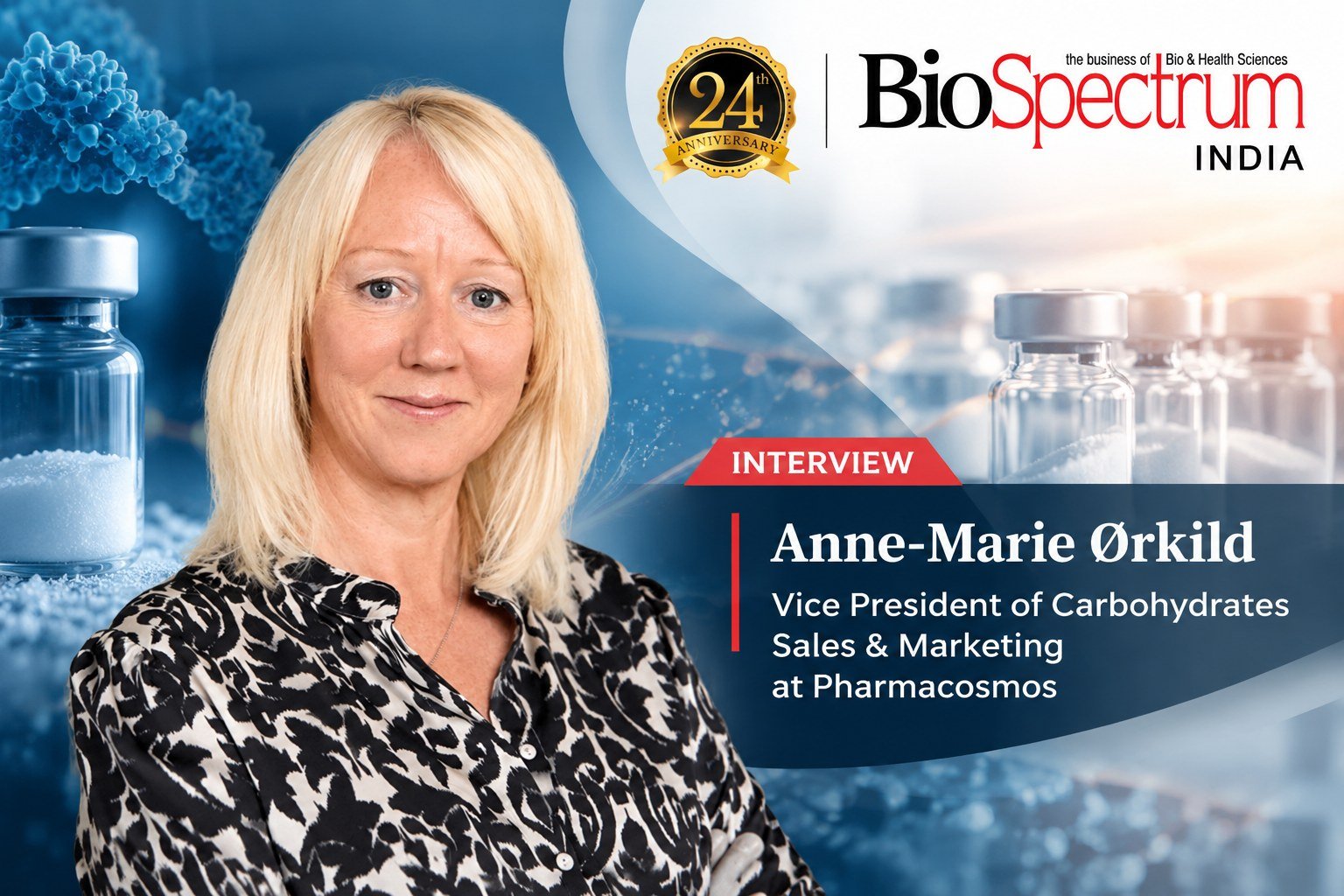
In an interaction with BioSpectrum India, Anne-Marie Ørkild, Vice President of Carbohydrates Sales & Marketing at Pharmacosmos, discusses how excipients are evolving from supporting ingredients into strategic formulation tools, the science behind Dextran 40 in lyophilised formulations, and how smarter formulation choices could contribute to more robust and scalable biopharmaceutical manufacturing in India and other growth markets.
Lyophilisation is critical for the stability of many biologics but can be time- and resource-intensive. What are the key formulation challenges today, and where do you see the greatest opportunities to improve efficiency?
Lyophilisation has become an essential tool for stabilising many sensitive pharmaceutical products, particularly proteins that may undergo chemical or physical degradation in solution. But it comes with an important trade-off: freeze-drying can be a long and costly process, and the formulation must protect the molecule through freezing, dehydration and subsequent storage.
One of the key challenges is the primary drying step. The temperature that can safely be applied is closely related to the glass transition temperature of the maximally freeze-concentrated formulation. Conventional cryo- and lyoprotectants such as sucrose and trehalose have relatively low glass transition temperatures, which can constrain the drying temperature and contribute to longer cycles.
This is where I believe there is an opportunity to think differently about excipient selection. An excipient should not only be considered for its ability to protect the active ingredient; its physicochemical properties can also influence the manufacturability of the formulation.
Research involving Pharmacosmos dextrans illustrates this very well. Dextrans have higher glass transition temperatures than sucrose, allowing higher primary drying temperatures to be investigated without collapse. In the published study from Strøm Larsen B., primary drying was completed in approximately 5 hours for the dextran-containing formulations compared with 16.5 hours for the sucrose formulation.
That demonstrates an interesting principle for drug developers: formulation and process efficiency do not necessarily have to be treated as separate optimisation exercises. The right excipient may contribute to both.
Recent findings indicate that Dextran 40 can significantly reduce primary drying time while improving protein stability. What makes dextran particularly effective in lyophilised formulations, and what could these findings mean for drug developers?
The key lies in the physicochemical properties of dextran, particularly its glass transition behaviour.
The study investigated dextrans across a range of molecular weights and found that both relevant glass transition temperatures generally increased with molecular weight before reaching a plateau at around 40 kDa. Dextran 40 therefore combined a relatively high glass transition temperature of the maximally freeze-concentrated solution with a high glass transition temperature of the dried material.
That matters in two ways. First, the higher glass transition temperature during processing allowed the dextran formulations to be dried at a higher primary drying temperature, significantly shortening primary drying. Second, the high glass transition temperature of the dried formulation was associated with improved stability during storage.
What is particularly interesting is that Dextran 40 performed strongly on both dimensions. In this LDH model, the Dextran 40 formulation retained approximately 97% protein activity immediately after freeze-drying and 94% after seven weeks at 40°C. The corresponding sucrose formulation retained approximately 86% immediately after freeze-drying and only 27% following storage at 40°C.
Importantly, these findings should be interpreted in the context of the LDH model system and the specific freeze-drying cycle used in the study, rather than as a universal prediction for all proteins or lyophilised formulations.
Protein stabilisation during lyophilisation is also multifactorial and may involve vitrification, preferential exclusion, water replacement, residual moisture, viscosity and molecular interactions, so glass transition behaviour should be viewed as a highly relevant but not exclusive explanatory factor.
For drug developers, the message is not that Dextran 40 will automatically be optimal for every molecule. Formulation development is always product-specific. But the results demonstrate that Dextran 40 deserves consideration as a functional pharmaceutical excipient capable of influencing both processability and protein protection, rather than simply as a conventional bulking agent.
Sucrose and other excipients are well established in freeze-drying. When should formulation scientists consider Dextran 40, and what advantages can it offer in terms of stability, robustness and processing?
Sucrose and trehalose have an established place in lyophilised formulations, and Dextran 40 should not be seen as a universal replacement. The more interesting question is whether formulators are considering the full range of excipient options available when an established formulation presents limitations.
Dextran 40 may be particularly interesting when formulators are looking to address challenges such as long primary drying times, limited processing temperatures or insufficient stability during storage.
The study by Strøm Larsen et al. provides a good illustration. The higher glass transition temperature of the dextran formulations allowed a higher primary drying temperature to be used. Under the investigated conditions, primary drying was completed in approximately 5 hours with dextran compared with 16.5 hours with sucrose, representing a reduction of more than 60%. Importantly, the resulting cakes remained visually acceptable, with no evidence of collapse and rapid rehydration.
Dextran 40 was particularly interesting from a stability perspective. It retained approximately 97% LDH activity immediately after freeze-drying and 94% after seven weeks at 40°C, compared with approximately 86% and 27%, respectively, for sucrose. At 60°C, the Dextran 40 formulation also showed no visual signs of cake collapse and retained substantially more LDH activity than the sucrose formulation.
Another important finding was that molecular weight matters. The relevant glass transition temperatures increased with dextran molecular weight before reaching a plateau at around 40 kDa. This means molecular weight itself can become another parameter for formulation scientists to consider when optimising a freeze-dried product.
In practical terms, the study highlights how excipient molecular weight and glass transition behaviour can be used more deliberately during lyophilised formulation design, while still requiring product-specific evaluation.
The broader message is therefore not that one excipient is always better than another. It is that excipient selection can influence both product stability and processability, and Dextran 40 provides an interesting additional option that formulators may want to evaluate alongside more conventional sugars.
As biologics, biosimilars, vaccines and complex injectables continue to grow, how are the expectations from excipients changing? Are they becoming a more strategic part of formulation and product development?
Absolutely. As pharmaceutical products become more complex, I think the role of excipients is evolving from being viewed primarily as supporting ingredients towards becoming strategic formulation tools.
For a sensitive biological molecule, the choice of excipient can influence much more than stability. It can affect the processing window, manufacturability, storage behaviour and ultimately the robustness of the finished product.
The dextran study provides another good illustration. Changing the cryo-/lyoprotectant influenced not only the protection of the model protein but also the temperature that could be applied during primary drying and, consequently, the processing time.
This means excipient selection should ideally be considered early in formulation development rather than simply optimising a process around familiar ingredients by default.
There is also a second dimension that becomes increasingly important as a product progresses towards clinical and commercial manufacturing: quality and consistency of the excipient itself. Developers need confidence that the material they select during development can be supplied consistently, at the required pharmaceutical quality and at the scale needed later in the product lifecycle.
So yes, I believe expectations are changing. The question is not simply “Does this excipient stabilise my molecule?” but also “What does it contribute to my formulation and process, how robust is it, and can I rely on its quality and supply as my product progresses?”
Beyond formulation performance, how can optimised lyophilisation contribute to manufacturing efficiency — particularly around drying cycles, equipment utilisation, energy consumption, scale-up and overall cost?
This is potentially one of the most commercially important aspects.
Lyophilisation is a time- and resource-intensive manufacturing process, and primary drying is typically one of its longest stages. If formulation optimisation allows that step to be shortened while maintaining product quality, there is potential to improve the overall efficiency of the manufacturing process.
The Strøm Larsen et al. study demonstrates the scale of the opportunity. Primary drying was completed after approximately 5 hours for dextran-containing formulations compared with 16.5 hours for sucrose. When a two-hour safety margin was incorporated into the experimental cycles, primary drying was set at 7 hours for dextran versus 18.5 hours for sucrose.
At manufacturing scale, reducing the time a product occupies a freeze-dryer could potentially translate into greater equipment availability, increased throughput and lower resource requirements per batch. It could also become relevant when manufacturers are scaling production or facing constraints in lyophilisation capacity.
However, it is important to distinguish between what the study demonstrated and the potential manufacturing implications. The research did not directly measure energy consumption, commercial manufacturing costs, throughput or large-scale equipment utilisation. Those benefits would need to be evaluated for each individual process.
What the study does demonstrate is that excipient selection can significantly influence primary drying time while maintaining product quality.
That is an important message because formulation development and manufacturing efficiency are sometimes treated as separate challenges. In reality, decisions made at formulation stage can have important implications for the process that eventually has to be scaled and commercialised.
Looking ahead, how do you see lyophilisation and formulation science evolving over the next five years, and what role could pharmaceutical-grade dextrans play as biopharma manufacturing expands in India and other growth markets?
I believe formulation science will become increasingly integrated with process development. As biologics, biosimilars, vaccines and other complex products continue to grow, developers will need formulations that do more than stabilise the active ingredient. They will increasingly look for solutions that also support robust manufacturing, scalability, storage stability and reliable commercial supply.
In lyophilisation, this should encourage a more systematic understanding of how excipient properties influence both product and process performance. This makes dextran particularly interesting because we should not think of it as one single excipient. Molecular weight, glass transition behaviour and interactions with the active ingredient can all become part of a more rational formulation design strategy.
For rapidly expanding pharmaceutical markets such as India, I believe this combination of formulation functionality, pharmaceutical quality and scalability will become increasingly important. As more products progress from development into larger-scale manufacturing, developers need not only innovative formulations but also confidence that their chosen excipients can follow them through that journey.
At Pharmacosmos, this is very much how we see our role. With more than 60 years of experience in pharmaceutical-grade carbohydrates, a dedicated cGMP manufacturing facility and a purely water-based dextran manufacturing process without organic solvents, we aim to be a long-term carbohydrate partner for formulation scientists.
Our broad range of dextran includes established pharmaceutical-quality grades such as Dextran 40, as well as a wide range of molecular weights, dextran derivatives and customised solutions. This allows us to support evolving formulation needs from early development through scale-up and commercial manufacturing.
Our ambition is therefore not simply to supply Dextran 40, but to help formulation scientists identify the carbohydrate solution that best fits their specific formulation and process needs.